2026 Real Estate Outlook – UK & Iberia
A 404 Capital outlook report on real estate in the UK and Iberia. Where the cycle sits, what is changing, and what we are watching into 2026.


EXECUTIVE SUMMARY
Western European Real Estate is closer to ending its repricing stage and transitioning into a buy-and-build part of the cycle. The rate shock is largely in the rear-view mirror, with refinancing taking place with less stress. Bank lending remains selective, and private credit continues to fill gaps where asset quality, cash flow, and execution are solid and clear. Private credit has attracted significant capital in recent years, and competition has tightened pricing in some pockets. Against that backdrop, some investor surveys point to a gradual re-opening of equity allocations and fund commitments as confidence improves.²²
Caution is also required because of heightened geopolitical risks in Eastern Europe and in Middle East. Such events incentivise a more cautious approach to underwriting and asset selection, even in Western Europe.
Therefore, we expect 2026-2028 to be predominantly income-led and disciplined. We expect real estate investors to seek strong cash-on-cash from Year 1 of their investments since the medium-term outlook is not absolutely clear. Although yield compression may return in pockets, it is unlikely to be the main or even secondary driver of returns. Hence, entry basis and operational execution matter.
In this context, we at 404 Capital (“404”) stay selective. We prioritise downside-first underwriting, clarity on cash flow, and business plans that can survive a slower economy, a higher cost of capital and even a minor escalation on NATO’s eastern frontier.
GENERAL MACRO & CAPITAL MARKETS BACKDROP
Rates are lower than a year ago, but the cost of capital remains meaningful. The Bank of England reduced Bank Rate to 3.75% in December 2025.¹ The ECB’s deposit facility rate is 2.00% (effective June 2025).²
Financial stability agencies remain focused on commercial real estate. The European Central Bank continues to highlight that tighter financial conditions can expose vulnerabilities in commercial real estate (“CRE”), with potential spillovers across banks and non-banks.³ The European Systemic Risk Board has recommended better monitoring of systemic risks in CRE, with refinancing pressure and tighter financial conditions cited as cyclical vulnerabilities.⁴ A separate Financial Stability Board report has also highlighted vulnerabilities among non-bank commercial real estate investors.⁵
Transaction liquidity is improving, but it is uneven. Activity tends to return first where pricing is transparent and financing is available. It lags severely where income is uncertain or capital structures are complicated.
Supply continues to tighten across much of Europe. High build and finance costs keep a lid on development starts, and the supply-demand imbalance remains a meaningful underwriting variable in several sectors.⁶ This supports modern, well-located assets, including assets that can be upgraded to modern standards. This, in turn, increases the penalty for assets that cannot meet occupier and sustainability requirements without meaningful capex. While sustainability has been somewhat less prominent in parts of the public discourse over the past year, large institutional owners, lenders, and many corporate occupiers continue to treat energy performance, disclosures, and credible decarbonisation pathways as relevant metrics. However, even if modern assets score highly on various environmental criteria like BREEAM, weak micro-location or an over-ambitious rent target can outweigh the promised sustainability perks. After all, location drives cash flow and cash flow is king!
UK OUTLOOK
1) Macro: slow growth, easing inflation, improving rate visibility
The UK enters 2026 with a “slow-but-stable” macro set-up. Growth is expected to be modest, while inflation is moving closer to target and policy is less restrictive than 12 to 18 months ago.
- Growth: Independent forecasters (HM Treasury comparison, Jan 2026) put 2026 UK GDP growth at ~1.0% (range 0.7%–1.3%).⁷
- Inflation: The Bank of England noted CPI inflation at 3.2% (Nov 2025) and expects inflation to fall back towards the 2% target more quickly in the near term as evidenced by the same HM Treasury survey that shows CPI inflation ~2.2% in 2026 (range 1.7%–3.1%).¹ ⁷
- Labour market: Unemployment is forecast at ~5.1% in 2026.⁷
- Policy rate: The Bank of England reduced Bank Rate to 3.75% in Dec 2025.¹
Bottom line: UK macro is not “boom” conditions. But the rate shock is probably behind us, and the range of plausible outcomes is narrower than it was. That helps liquidity and pricing discovery.
2) Capital markets: liquidity is returning, but it is selective
UK transaction markets are moving from “stalled” to “functioning”, with activity concentrated where income is legible and debt is available.
- Investment volumes: CBRE reports £9.8bn of UK commercial real estate investment in Q3 2025, taking year-to-date (end Q3) to £33bn.⁸
- Large, liquid sectors returning first: Savills stated that office and industrial volumes in 2025 were tracking to exceed 2024’s £21bn combined total (directional, not whole market).⁹
- Pricing / yields: DWS’s UK view is that prime yields were “largely stable through 2025”, with exceptions (including London City offices and select retail). They also note that if financing costs fall, yield compression is an “upside risk” into 2026.¹⁵
- Living, BTR pipeline evidence: CBRE data points to £1.9bn of BTR investment in H1 2025, with a further ~£2.2bn under offer at the time of release.¹⁰
- Debt markets (practical takeaways): Across Europe, lender competition has improved and terms have moved. DWS notes typical senior LTVs of ~55%–65% (including for offices), tightening lending margins in 2025 (especially prime), and that lenders re-entered faster than buyers, creating windows where debt is relatively competitive versus transaction volumes.¹⁶
Bottom line: Liquidity is improving, but it is uneven. The “default” outcome is still selectivity: clear cash flow, sensible capex, and structures that work under a higher cost of capital.
404 View: The UK appears to be approaching an inflection point. If rates continue to stabilise and refinancing pressure drives motivated outcomes in select situations, this can support well-timed entry for the right product, particularly where cash flow resilience and deliverability are underwritten. In particular, special situations are of great interest: good real estate where there is capital structure pressure or timing constraints, and where speed, structuring and execution certainty matter.
404 is based in London and considers the UK its local market. We have direct experience across both real estate equity and debt investments, working with operators and intermediaries across a range of asset classes.
SPAIN OUTLOOK
1) Macro: Spain keeps outperforming, with better financing visibility
Spain remains in an expansionary cycle led primarily by domestic demand. The European Commission’s latest country forecast supports the view that inflation continues easing into 2026, with domestic demand remaining a key driver.¹¹
Rate visibility is also improving. CBRE’s latest Spain outlook characterises monetary policy as entering a more stable phase, with rates seen around the current ~2% level and limited expectation of near-term shifts, which typically supports liquidity, underwriting confidence, and price discovery.¹²
Tourism remains a material tailwind for Spain’s broader economy and many real estate strategies. Official figures indicate ~97 million international tourists in 2025 (+3.5% YoY) and international tourism spending near €135bn (+6.8% YoY).¹³
Bottom line: Spain goes into 2026 with growth plus improving financing visibility, a combination that historically supports both real estate activity and capital allocation.
2) Capital markets: volumes are back, at scale
Real estate capital has already signalled its return. CBRE reports Spain closed 2025 with €18.4bn+ of investment (+31% YoY), the strongest year since 2018.¹²
Looking into 2026, CBRE expects the market to remain in expansion mode, forecasting +5% to +10% growth in investment volumes.¹²
On financing, the direction of travel is also supportive. CBRE points to increased activity from both local and international banks, with lower costs and higher leverage, alongside continued competition from alternative lenders, broadening options across the capital stack.¹²
Bottom line: Spain’s capital markets look meaningfully more functional than they did 12 to 18 months ago. Volumes have recovered, lender appetite has broadened, and competition across the capital stack is improving, which supports pricing discovery. Even so, liquidity remains asset-specific and underwriting still needs to separate durable cash flow from cyclical noise. In this part of the cycle, well-timed entry is most credible where the business plan is execution-led and the asset sits in segments with clear demand and constrained supply.
3) Living takes centre stage: residential plus alternatives
If one segment best captures Spain’s combination of demand strength and institutional conviction, it is the Living sector, which includes traditional residential as well as, for example, student housing, co-living, and senior living.
- Traditional residential: Spain’s housing market remains structurally undersupplied. The Bank of Spain has cited a housing shortfall around ~700k homes, with the deficit continuing to widen absent a step change in deliveries.¹⁴ That imbalance helps explain why pricing and rents stay supported, even as the market normalises into a more sustainable pace.
- Living as the primary destination for institutional capital: CBRE’s outlook is explicit that Living remains a leading destination for real estate investment in Spain, anchored by rental demand and sustained institutional appetite.¹²
- Alternatives are becoming core, not adjacent: student housing, flex living, and senior living are increasingly central components of institutional Living strategies, helping investors diversify income streams, extend duration, and align product with evolving housing needs.¹²
404 View: Spain’s capital markets look increasingly functional going into 2026, with clearer pricing discovery and broader financing options than 12 to 18 months ago. This is supportive for well-timed entry, but we remain selective and focus on situations where underwriting is driven by durable cash flow and controllable execution. In Spain, we are most constructive where demand is structural and supply is constrained, particularly across Living and operational formats, and where business plans are based on repositioning, operating improvement, or platform build rather than relying on broad yield compression.
404’s CFO & COO, Alberto Garcia de Novales, is from Spain with more than a decade of direct real estate experience throughout the country. This direct connection allows 404 to deeply understand the local market and knowledgeably underwrite investments.
PORTUGAL OUTLOOK
Portugal enters 2026 with a relatively stable macro set-up, supported by domestic demand and EU funding flows, with inflation close to target and the labour market still firm.¹⁷ ¹⁸ From a real estate underwriting perspective, the near-term question is less about headline growth and more about how quickly financing conditions and pricing expectations converge across sectors and deal sizes.
1) Macro: steady growth, inflation near target, housing constraints remain a live issue
The European Commission’s latest forecast expects Portugal’s GDP growth at 2.2% in 2026, with inflation at 2.0% and unemployment at 6.2%.¹⁷ The same forecast frames domestic demand as the key support for growth, with investment also helped by EU funds.¹⁷
Separately, the Organisation for Economic Co-operation and Development flags housing affordability and permitting as structural constraints, and explicitly links improved affordability to reforms in permitting and spatial planning.¹⁸ This matters for real estate because it can influence delivery pipelines, absorption, and the political sensitivity of housing-related strategies.
Bottom line: Portugal’s macro picture going into 2026 looks stable rather than expansive. Growth is not the point. Visibility is. That tends to support pricing discovery, particularly where income is legible and the financing path is clear.¹⁷
2) Capital markets: improving liquidity, still deal-specific
Portugal’s transaction market remains smaller than the UK or Spain, but it can move quickly when pricing clears and product is scarce. CBRE’s Portugal outlook expects investment volumes potentially reaching €2.5bn, described as ~8% year-on-year growth, with retail and hotels expected to attract a large share of investment.¹⁹
JLL’s Q3 2025 snapshot also points to improving activity, with investment volume at €1.85bn across the first three quarters of 2025, and retail highlighted as a leading share of volume in that period.²⁰
Bottom line: Liquidity in Portugal is improving, and the market is functioning. The dispersion is still wide by sector and lot size. The practical implication is selectivity on entry basis, tenant quality, and financing structure, with a bias toward situations where execution risk is measurable and controllable.¹⁹ ²⁰
3) Broad Sectoral Overview
Portugal remains a “market of nodes”, with liquidity and occupational depth concentrated in a small number of locations and submarkets:
- Hotels and retail have been meaningful sources of investment activity, alongside selective interest in living and logistics.¹⁹ ²⁰
- Housing and affordability are politically sensitive, which can shape planning, permitting and the risk of rule changes at the margin.¹⁸
- In hospitality, tourist accommodation activity has remained supportive, with revenue growth still showing through in 2025 data.²¹
404 View: Due to lower liquidity and a more localised market, we remain selective and apply a higher bar on entry basis, tenant quality and financing structure. Portugal can offer a relatively stable operating environment, with investable situations that tend to be location-specific and execution-led, particularly in the main urban nodes.
In Q4 2025, 404’s Founder and CEO, Vlad Pent, spent a week in Lisbon meeting brokers and potential operating partners across Lisbon and Porto as part of our ongoing market work.
GEOPOLITICS
Geopolitical risk remains elevated in the world as well as in Europe, particularly due to the ongoing war in Ukraine and broader security uncertainty on EU’s eastern flank. We do not underwrite geopolitical outcomes. Instead, we reflect this backdrop through stress-testing on growth, inflation and rates, and through a preference for situations where downside protection is clear, financing is robust to re-pricing risk, and business plans do not rely on benign macro conditions.
404 CLOCK: CYCLE POSITIONING TOOL
We use a cycle-clock heuristic (“404 Clock”) to describe where markets sit in the cycle. It is a simplification, but it helps visualise and frame our understanding of the property cycle.
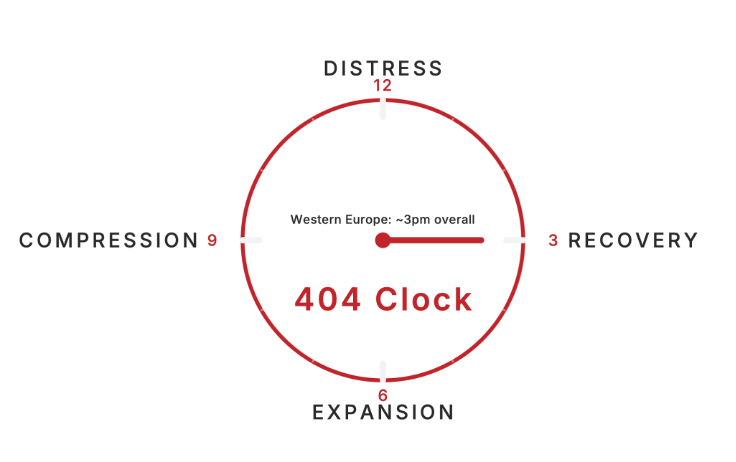
The four property cycle states are:
- Distress (12 to 3): dislocation is clear; vacancies rise and capital structures come under pressure, increasing the prevalence of forced selling and rescue capital.
- Recovery (3 to 6): distress recedes; pricing stabilises and upside begins to re-emerge for income-led and buy-and-build strategies as liquidity improves.
- Expansion (6 to 9): conditions strengthen; occupier demand and rent growth become more supportive and development viability improves.
- Yield Compression (9 to 12): liquidity is abundant; cap-rate compression can become a meaningful return driver as investors trade down the yield curve.
Our view is that the UK is around 3 and Spain is around 6 due its stronger economy and buoyant RE market, with dispersion by sector and submarket. Portugal sits somewhere in the middle between the two at around 4:30.
The implication is selectivity. We remain open to light distress where capital structures drive motivated outcomes, and to buy-and-build or platform strategies where entry basis and execution can be tightly controlled.
URBAN THESIS
Lastly, for 2026 and beyond, we expect leading urban centres, such as London, Madrid and Lisbon, to remain structurally advantaged as demand concentrates around deep labour pools, strong transport links, and amenity-rich environments that support collaboration and retention. We also expect technology adoption, including AI-enabled workflows, to amplify the value of dense ecosystems where companies, universities and specialist suppliers cluster. In that context, we remain most interested in situations where entry basis is defensible and value can be created through leasing, targeted capex and operational execution, including selective special situations where structuring and certainty of close matter.
About 404 Capital
404 Capital ("404") is a real estate investment management platform investing across value-add and opportunistic situations. We deploy both equity and credit, focusing on opportunities where mispricing, complexity, or transition creates the potential for compelling risk-adjusted outcomes.
404 combines institutional-grade governance, disciplined underwriting, and technology-enabled processes with hands-on, operator-led execution. Our primary geographic focus is the United Kingdom and Iberia, with selective expansion across Europe through trusted and professional local partners.
Disclaimer (verbatim)
For professional investors only; not intended for retail clients. 404 Capital Ltd is not authorised or regulated by the FCA. This material is for discussion purposes only and does not constitute investment, legal or tax advice.
Appendix: Selected third-party research extracts (paraphrased)
- DWS’ Europe outlook highlights that the UK recovery is slow but improving, with select opportunities for active investors, and notes a potential value-add angle in Central London where well-located office upgrades can close part of the quality gap, with the City of London positioned to benefit if yield compression returns.¹⁶
- DWS’ UK outlook frames 2025 as a transition year with improving transaction conditions in parts of the market, and points to sector dispersion that can create opportunities where leasing and repositioning plans are credible.¹⁵
- Green Street survey evidence indicates a rising share of investors expect to increase allocations to private real estate equity funds as confidence improves.²²
References
- Bank of England, "Monetary Policy Summary and minutes, December 2025" (18 Dec 2025).
- European Central Bank, "Key ECB interest rates" (deposit facility rate effective 11 Jun 2025).
- European Central Bank, Financial Stability Review (commercial real estate sections, latest cited in draft).
- European Systemic Risk Board, recommendation / communication on commercial real estate vulnerabilities (25 Jan 2023).
- Financial Stability Board, "Vulnerabilities in Non-bank Commercial Real Estate Investors" (19 Jun 2025).
- CBRE, "European Real Estate Market Outlook 2026" (supply / development pipeline commentary).
- HM Treasury, "Forecasts for the UK economy: January 2026 (comparison of independent forecasts)" (21 Jan 2026).
- CBRE, UK commercial real estate investment update, Q3 2025 (Q3 volume and YTD total).
- Savills, statement / release on 2025 office and industrial volumes tracking above 2024 combined total (14 Oct 2025).
- CBRE, UK Build-to-Rent investment figures, H1 2025 (and "under offer" pipeline at release date).
- European Commission, Spain country economic forecast page / release (latest cited in draft).
- CBRE Spain, "Spain Real Estate Strategic Outlook 2026" (investment volume, 2026 outlook, financing commentary).
- Ministerio de Industria y Turismo (Spain), official release on 2025 international tourism arrivals and spending.
- Bank of Spain, public estimate of Spain housing shortfall (c. 700k homes) as cited in published materials.
- DWS, Real Estate Strategic Outlook: UK (Dec 2025).
- DWS, Europe Real Estate Strategic Outlook (Dec 2025).
- European Commission, Portugal economic forecast (17 Nov 2025).
- OECD, OECD Economic Surveys: Portugal 2026 (6 Jan 2026).
- CBRE Portugal, "Real Estate Market Outlook 2026 Portugal" (capital markets and financing conditions).
- JLL, "Portugal Capital Markets / Market Dynamics, Q3 2025" (investment volume and sector mix).
- Statistics Portugal (INE), tourism activity press release (2025 data cited in draft).
- Green Street News/INREV, "Investors return to funds as confidence grows" (investor expectations on increasing equity fund allocations).